For years, I’ve used Procreate to draw over photographs of buildings. A plain wall becomes a place for a character. An architectural detail suggests something unexpected. The building stays recognizable, but the illustration changes how you see it.
Living Murals grew out of that practice. I wanted other people to have a little of that experience: put something imaginative into a familiar setting, move it around, make a picture, enjoy the result.
The early experiments made me reconsider what I was asking people to do first. Download an app? Wait for a surface to register? Learn how to place an object before the kids lost interest?
I started paying more attention to the distance between curiosity and enjoyment.
That led toward a browser-based experience. The free tools require no app download, account or credit card. People can move illustrated cutouts around their camera view, or use a separate photo booth to replace the background behind them. Photos and videos are composed on the device rather than uploaded by the tools.
There are compromises. The cutouts sit on the screen; they don’t remain attached to a physical wall as you walk around. Props are positioned by hand. Background separation has limits. These are things to test and explain, rather than hide behind the broad promise of “AR.”
AI-assisted development has helped me build and explore the project. My work has been a combination of creative direction, testing and deciding what to keep, simplify or abandon. Having more things we could build hasn’t relieved me of deciding which ones belong.
Then I noticed a similar problem on the website.
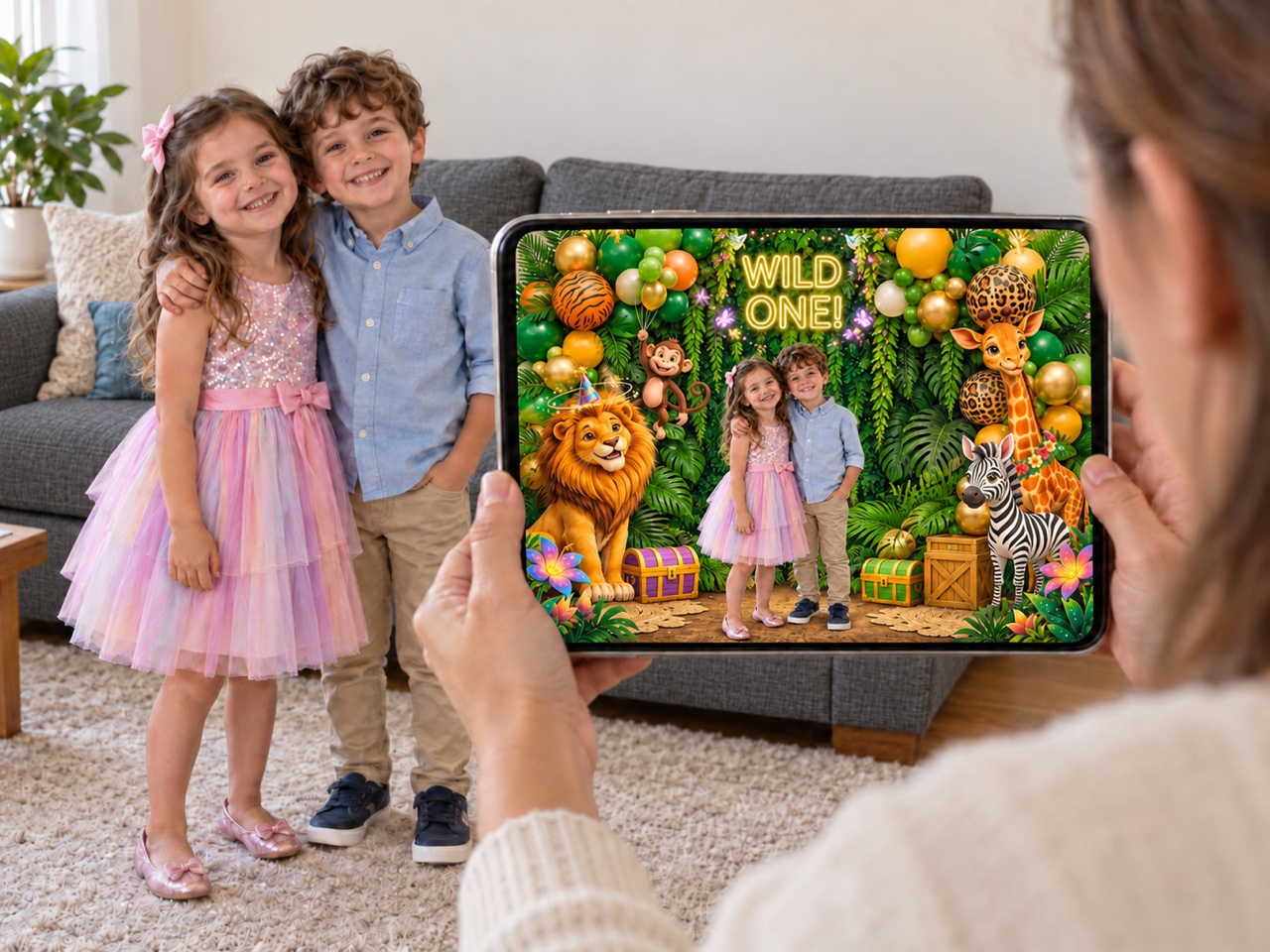
The hero images looked good. Some looked very good. But a finished party picture didn’t necessarily explain what Living Murals let someone do. It could just as easily suggest decorations for sale or inspiration for a birthday party.
A mother holding a phone in a plain living room tells a different story. The children are there in front of her. On the screen, they’re standing in a playful illustrated setting. You can see the relationship between the ordinary room and the picture she’s making.
That is the direction we’re taking with the demonstrations. Illustrative examples can explain the idea, provided they’re identified honestly. Real product captures need to show what actually happens.
A small group of friends tried the experience and liked it. I’m encouraged, but we’re still learning. For now, the aim is free, accessible creative play, and the next useful evidence is whether people can understand it, use it and enjoy it without me standing beside them.
I knew what I was inviting them to do. The website still had to make that invitation visible.
Continue exploringRead more from The Clarity System →