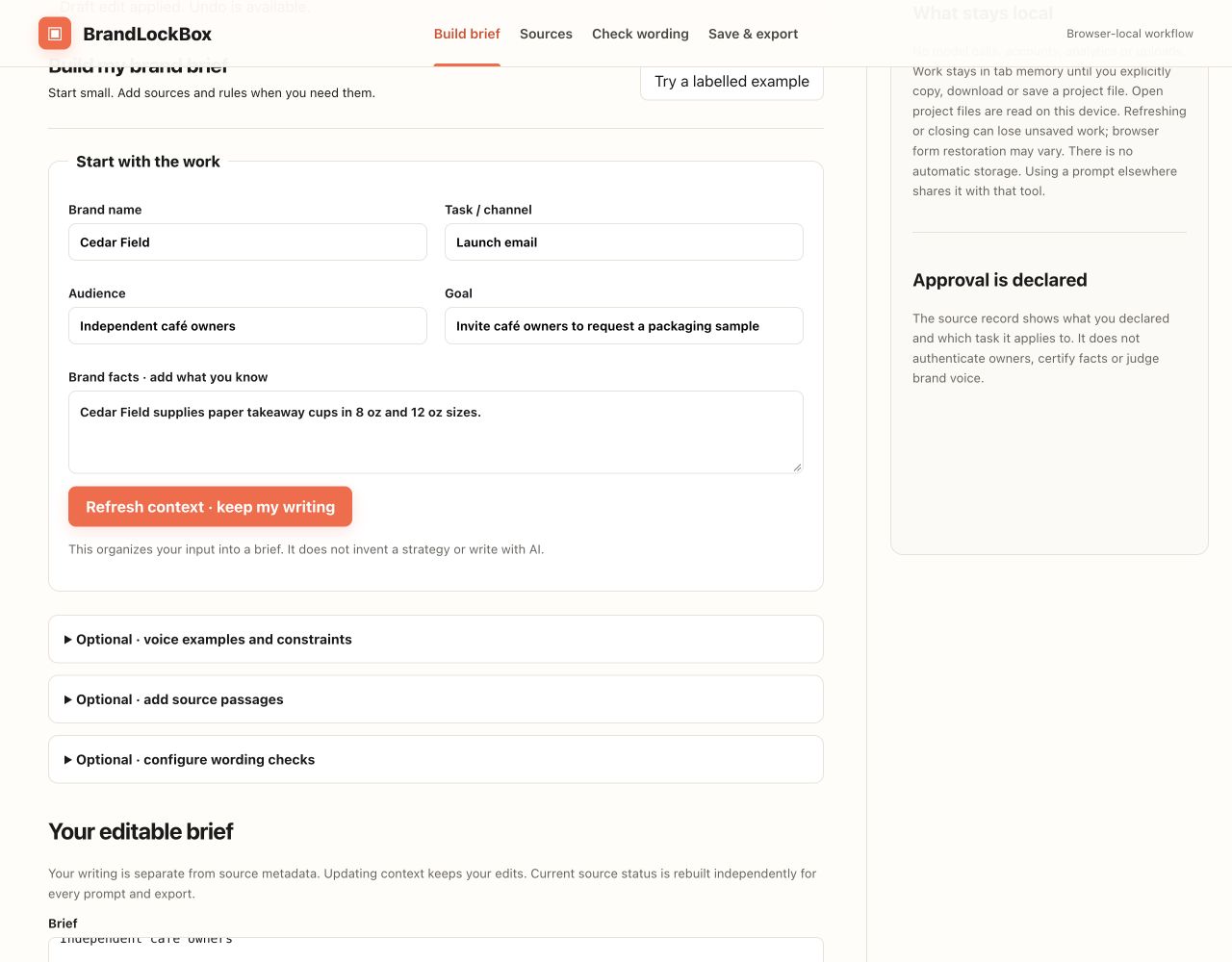
From positioning to production release: a browser-based workflow for building an editable brand brief, inspecting source limits, and checking configured wording.
3 paths
Create, find, or check from one task-first home
4 steps
Facts → Brief → Review → Export
16 checks
Logic regression checks passed, plus browser and mobile verification
Live
Deployed on the existing brandlockbox.com Pages project
01 / The Problem
Brand documents can describe identity without helping someone write the next email, page or presentation. The initial BrandLockBox direction explored a Command Center that starts with the job, brings relevant guidance into view and keeps source context inspectable.
The earlier React concept used fixture content to communicate that vision. The next step was to test whether the experience could handle someone’s actual inputs and produce a usable result.
02 / The Working Workflow
The deployed application starts with brand name, task, audience, goal and known facts. Voice examples, constraints, source passages and wording rules are optional sections. It organizes those supplied inputs into an editable brief and a portable prompt; it does not invent a strategy or generate copy with AI.
03 / Adversarial Review
The adversarial review exposed four concrete failures: old approved context could remain in an export after a source became outdated; loading the example could overwrite source-only input; compatible excerpts were incorrectly treated as conflicts; and empty replacements could leave broken sentences.
The correction pass rebuilds current context for every export and requires review after source or input changes. Refresh preserves manual writing. Stable document and passage identities allow compatible excerpts while competing approved versions or explicitly linked competing claims are excluded. Replacement previews, deliberate whole-sentence removal and Undo protect the draft. Reset and import also require confirmation and retain a recovery snapshot.
04 / SEO, AEO & GEO
The application received a descriptive title and meta description, canonical URL, Open Graph and Twitter cards, an actual 1200 × 630 sharing image, favicon, robots controls and a one-page sitemap. Static product explanations and seven answer sections describe the workflow, source approvals, storage, AI-tool handoff and limits.
WebSite, WebApplication and FAQPage structured data matches the visible content. Production and preview bundles have separate indexing controls. A supplemental llms.txt describes the same capabilities without promising answer-engine inclusion. This case study’s metadata, social image and Article/FAQ markup now describe the deployed workflow.
AEO and GEO preparation means giving search and answer systems clear, crawlable, accurate material. It does not establish ranking gains, AI citations or rich-result eligibility. Those outcomes have not been measured.
05 / Implementation & Verification
The working release uses dependency-free HTML, CSS and JavaScript, retaining the cream-and-coral visual direction. No model, account system or application backend is required. Work stays in browser tab memory unless explicitly copied or saved; ordinary page requests reach the hosting provider.
Sixteen logic regression checks passed. Browser verification covered three fictional brand tasks, input fidelity, missing and competing guidance, edit preservation, reset/Undo, prohibited wording, local project roundtrip and manual copy. Mobile verification at 390 pixels showed no horizontal overflow.
The release was deployed to the existing Cloudflare Pages project. Public HTML, scripts, styles, robots, sitemap, llms.txt and sharing image matched the release package. Security headers, legacy redirects and a real 404 response were checked. The previous deployment and its public assets were preserved for rollback.
06 / Current Status
BrandLockBox is live at brandlockbox.com. Create, source inspection, configured wording checks and local export/reuse are working controls rather than static concept screens.
The checker is a deterministic wording tool. It cannot verify product facts or numbers, detect paraphrased claims, judge brand voice, evaluate evidence quality or authenticate approvals. Source status is declared by the user. There is no automatic persistent storage, collaboration or durable approval history.
The work demonstrates a complete loop from product framing through adversarial review, implementation, deployment and public verification. Customer adoption, conversion lift and search performance remain unmeasured.
07 / Questions & Answers
The deployed application builds an editable brief and portable prompt from supplied brand facts, audience, goal, voice examples and source passages. It supports literal wording checks, Markdown export and local project save/reopen.
Exports now rebuild current source context and require review after input changes. Context refresh preserves edited writing. Compatible source passages can coexist, and corrections use full sentence previews with Undo.
The application received descriptive metadata, a canonical URL, Open Graph and Twitter sharing tags, a 1200 by 630 sharing image, robots controls, a sitemap and structured data that matches seven visible product answers. The case study also has current metadata and matching answer content.
No. It matches configured prohibited phrases, missing required phrases and complete excluded source passages. It does not validate facts, detect paraphrased claims, judge brand voice or authenticate source approvals.
BrandLockBox was one of seven production products I shipped in 60 days. It shows how I use AI to shorten the path from strategy to evidence, while marketing experience guides what is worth building. I’m interested in Marketing Director and senior marketing leadership roles with B2B organizations ready to build marketing as a real capability.